Ritual is one of the reasons I love tea so much, and it is probably the main reason I want to share it with others. I always have a ritual for tea, because the rituals of tea can really only be contained for me in a way of life. In
The Book of Tea Okakura Kakuzo imagined this way of life as
teaism, and describes it as a celebration of beauty and a chance to meditate on weightier things. The ceremony of tea is a time to stop and be enraptured by smells, sounds, tastes and sight. It is a rare occasion when the oldest objects filled with the most imperfections are the most praised, and the taste most strived-for is one that brings us closer to nature and the origins of the leaves. The rituals of tea offer a way to find moments of peace and appreciate the simple things in a world that goes by all too fast. To quote Kakuzo once again, "“those who cannot feel the littleness of great things are apt to overlook the greatness of little things.” I want to feel both of these, and so, the ritual of tea. This ritual, however, is not at all complicated. Its simplicity allows it to apply equally to gongfu cha and chanoyu, English style teapots and great steamy mugs, tea bags and leaves in a tall chipped glass.
For me, the ritual of tea is this: when drinking tea, cultivate awareness- try to understand everything you are sensing and feeling (both the what and the why) and seek to appreciate beauty in all that you can.
Since this morning's gaiwan of green, the day has been full of teas of all types. I visited the Minneapolis Institute of Art and, inspired by all of the beautiful Song Dynasty teaware ceramics, I thought I'd see what it was like to make tea Song Dynasty style. This required my mortar and pestle.

Into the mortar went some high quality spring
Lao Shan green tea, and after an hour or so, it was ground into a find (matcha-like perhaps?) powder.


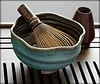
We brewed and whisked it, and it actually turned out rather nicely! It was sweet and not too bitter, but it didn't have as much of the bean-y-ness from the Lao Shan green as I might have hoped. I am now more eager than ever to really begin my study of Japanese green teas.
Since that experiment was so much fun, we decided to try it with puer ala Lu Yu the Tea Sage's instructions. Not wanting to risk our old shengs on a possibly disastrous experiment, we decided to use a nice, caramel-y, easy-to-drink
shou.


The results were also quite good! Grinding the puer resulted in that very old puer taste. It was sweet and very thick (though not at all sickly sweet). Interestingly, the caramel taste that characterized this brick of shou was lost in the grinding. My final conclusion is that this method results in a fine brew, but not nearly as good as it would have been steeped with whole leaves.
But was that the end of our tea drinking for the day? Not on such a cold rainy day as this. My mother and sister came over for pre-Mother's Day dinner, and we shared two teas (one before and one after):
Jasmine in a large glass teapot (poured into mugs); extremely excellent
Qi Lan Da Hong Pao (Big Red Robe oolong) done gong fu style in two yixing clay teapots.
Finally, to drive away the chills of the last of the evening, we had some
roasted Tieguanyin in our large teapot.

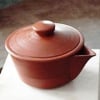


 ), and go to work. During each subsequent water heating/steeping, I continue whatever I'm doing throughout.