
I find this concept fascinating. Could you please direct me to some place where I can learn more about it?betta wrote:Dissolving ionic solids and reversing crystal formation could be done easily. That's what we learn in highschool. However I hope you'd take into account the capillary effect in the deposition. A capillary condensation (and thus also deposition) will create hysteresis, not all of the deposited molecule could be easily removed out of pores. Otherwise we don't have to replace any adsorbent after some TON.
interesting thread ....
The Tek Sing wreck had yixing teapots on it as well.
In reading about the desaru teapots, one website mentions that the marks on the bottom might be spurious ... that does not mean they are not from the 1830's, but rather the potter might not be the famous potter whose mark appears.
I just read the book "Dragon Sea" about the Hoi An horde. No yixing tea pots, but a fantastic assortment of early 15th c ceramics.
I like shipwreck pottery as it is a great way to get incredibly rare pieces that otherwise would be hard to collect.
The pots are a little out of my league, and if I did own one, I would probably brew a pot or two out of it for kicks, but don't think it could ever be a utility pot.
Other wrecks include the "Nanking Cargo" that has european style (export) pottery. Tea cups at that time (1750) did not have handles, though coffee cups did ..
The Tek Sing wreck had yixing teapots on it as well.
In reading about the desaru teapots, one website mentions that the marks on the bottom might be spurious ... that does not mean they are not from the 1830's, but rather the potter might not be the famous potter whose mark appears.
I just read the book "Dragon Sea" about the Hoi An horde. No yixing tea pots, but a fantastic assortment of early 15th c ceramics.
I like shipwreck pottery as it is a great way to get incredibly rare pieces that otherwise would be hard to collect.
The pots are a little out of my league, and if I did own one, I would probably brew a pot or two out of it for kicks, but don't think it could ever be a utility pot.
Other wrecks include the "Nanking Cargo" that has european style (export) pottery. Tea cups at that time (1750) did not have handles, though coffee cups did ..
Here is my penny.betta wrote:I don't know exactly what the collector after from these pots. I hope kyleshen in this forum could help us with this part; he's the expert.Drax wrote:I don't agree. I could write several pages explaining the principles of dissolving ionic solids and reversible crystal formation, but I don't think anybody really cares about that stuff.hop_goblin wrote:Thanks for the analysis! Great!
Bottom line for me is that $320-$800 is a lot to pay for a pot, even if it's 150 years old. I'm sure plenty of antique collectors are drooling over the possibilities, whether they would brew tea in it or not.
Dissolving ionic solids and reversing crystal formation could be done easily. That's what we learn in highschool. However I hope you'd take into account the capillary effect in the deposition. A capillary condensation (and thus also deposition) will create hysteresis, not all of the deposited molecule could be easily removed out of pores. Otherwise we don't have to replace any adsorbent after some TON.
Yixing ware is actually not easy to date so dated ship-wreck teapots are great for reference in shape, materials and method of formation.
For your information, I have seen collectors who nourish these teapots back to usable condition after lots of tea steeping.
The better ones (in terms of workmanship and desirable shape) have gone over the years but the price of the remaining ones are still acceptable.
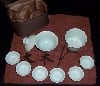
My tea master has a pot recovered from one of these wrecks (not sure which one), and he's now conditioning it for making tea. He thinks it will take at least a month or so before it's ready. I'll post more when I learn more about how he's treating it.
"The meaning of life can be found in a good cup of tea."
Check out more Taiwan tea stories (with photos) at taiwanteaguy.com
Check out more Taiwan tea stories (with photos) at taiwanteaguy.com
Hey teaguy, did you ever find out the steps he was going through to condition the pot?teaguy wrote:My tea master has a pot recovered from one of these wrecks (not sure which one), and he's now conditioning it for making tea. He thinks it will take at least a month or so before it's ready. I'll post more when I learn more about how he's treating it.
By the way, it looks like they've restocked with more pots. . .[/url]

Mar 16th, '09, 19:58
Posts: 1936
Joined: May 22nd, '06, 11:28
Location: Trapped inside a bamboo tong!
Contact:
hop_goblin
Don't always believe what you think!
http://www.ancientteahorseroad.blogspot.com
http://englishtea.us/
http://www.ancientteahorseroad.blogspot.com
http://englishtea.us/


this is the one I would want.... I would be buying it solely for the purpose of having/displaying it. the fact that a shellfish grew to maturity in this pot (assuming the reason the shell is still in there is it is too large to remove) would make a very cool conversation item.Ser. No. D-793
This teapot is intact except for a chipped spout and a very small chip on the inside of the lid. The base shows the mark of Shou Yaolan a famous teapot maker. In addition to the mark there is a sea shell in the bottom of the pot, confirming its stay on the sea bed.

Hi Drax,
Actually, he's tried a lot of different things with it, but has pretty much given up on ever using it to brew tea. Maybe it needs another 200 years soaking if fresh water in a lake somewhere! lol
His opinion is that those recovered pots are more valuable as a record of the times. From ship's records and other data they can pinpoint within a fairly narrow time frame when the tea ware was made, so those pots provide a good base line for comparing other pots to help date things more accurately.
The porcelain wares would probably be more practical for actually brewing, as they would be easier to clean up.
I'm curious myself as to what the taste difference would be, and if it would really ruin the tea or just alter it a bit - Master Tsai is a much more sophisticated tea drinker than I am, and perhaps he picks out subtle qualities that wouldn't bother a less sensitive palate such as my own.
Would love to hear from anyone actually using a recovered pot. I'm tempted to splurge on one of the cheaper ones myself, just to have around.
Actually, he's tried a lot of different things with it, but has pretty much given up on ever using it to brew tea. Maybe it needs another 200 years soaking if fresh water in a lake somewhere! lol
His opinion is that those recovered pots are more valuable as a record of the times. From ship's records and other data they can pinpoint within a fairly narrow time frame when the tea ware was made, so those pots provide a good base line for comparing other pots to help date things more accurately.
The porcelain wares would probably be more practical for actually brewing, as they would be easier to clean up.
I'm curious myself as to what the taste difference would be, and if it would really ruin the tea or just alter it a bit - Master Tsai is a much more sophisticated tea drinker than I am, and perhaps he picks out subtle qualities that wouldn't bother a less sensitive palate such as my own.
Would love to hear from anyone actually using a recovered pot. I'm tempted to splurge on one of the cheaper ones myself, just to have around.
"The meaning of life can be found in a good cup of tea."
Check out more Taiwan tea stories (with photos) at taiwanteaguy.com
Check out more Taiwan tea stories (with photos) at taiwanteaguy.com
Salt is the least of your worries.
The rate of contaminant efflux with vary with physical and chemical properties of the clay interior and the overlying seawater.
There are very interesting microbial critters that could inhabit the micro-pore surface, living nicely off the bound ions, both ionic and covalent.
Methinks there would indeed be an odd flavor to tea made in these pots.
Their value lies in their age, provenance and unusual marine storage conditions.
Tek Sing Treasure:
http://www.worldcollectorsnet.com/magaz ... s18p4.html
"It was during the relatively peaceful Ming times that this fertile area gave rise to a rich and cultured elite society, whose traditions included the taking of tea. These merchants, officials and scholars as well as aristocrats required the finest tea and by the sixteenth century there was a great appreciation of the red-bodied teapots produced at Yixing. It became a matter not only of pleasure but also of status to order - or indeed sometimes to help the potter to produce - the finest possible teapots. In Ming times and later, inscriptions were of great importance. They could be extracts from poems both old and modern, and in some cases the simple but elegant forms of the vessels were no more than vehicles for fine calligraphy.
The tea-drinkers of Jiangsu and Zhejiang provinces eschewed what they deemed the more gaudy decorative products of Jingdezhen, and the gold and silver pots favored in some quarters. On the practical side, these unglazed pots kept the tea warm for longer, retained aroma better and were usually small enough to help avoid wasting an expensive commodity. The eighteenth century saw a decline in interest in tea and the quality of Yixing teapots, but there was a revival at the start of the nineteenth century, though earlier heights were never reached again.
All the teapots from the cargo have the traditional elegant simplicity of these wares. Some of the shapes have the maker’s name and others have poetic inscriptions on their bases. While there is a long history of exporting Yixing teapots, it is perhaps surprising to find inscribed ones in the cargo. Presumably they were destined for some of the island’s emigrant Chinese communities, where such cultural objects would be appreciated among certain classes. It is interesting that one of the Yixing teapots recovered from the Nanking cargo, salvaged in 1985 and whose wares date from circa 1750, appears very similar to the bullet-shaped teapots in the present cargo. Given the small number, it is not impossible that the latter were ‘old stock’ recovered from some warehouse, but it is more likely that some of the older types continued to be made alongside newer, more refined versions that were part of the revival."
There are very interesting microbial critters that could inhabit the micro-pore surface, living nicely off the bound ions, both ionic and covalent.
Methinks there would indeed be an odd flavor to tea made in these pots.
Their value lies in their age, provenance and unusual marine storage conditions.
Tek Sing Treasure:
http://www.worldcollectorsnet.com/magaz ... s18p4.html
"It was during the relatively peaceful Ming times that this fertile area gave rise to a rich and cultured elite society, whose traditions included the taking of tea. These merchants, officials and scholars as well as aristocrats required the finest tea and by the sixteenth century there was a great appreciation of the red-bodied teapots produced at Yixing. It became a matter not only of pleasure but also of status to order - or indeed sometimes to help the potter to produce - the finest possible teapots. In Ming times and later, inscriptions were of great importance. They could be extracts from poems both old and modern, and in some cases the simple but elegant forms of the vessels were no more than vehicles for fine calligraphy.
The tea-drinkers of Jiangsu and Zhejiang provinces eschewed what they deemed the more gaudy decorative products of Jingdezhen, and the gold and silver pots favored in some quarters. On the practical side, these unglazed pots kept the tea warm for longer, retained aroma better and were usually small enough to help avoid wasting an expensive commodity. The eighteenth century saw a decline in interest in tea and the quality of Yixing teapots, but there was a revival at the start of the nineteenth century, though earlier heights were never reached again.
All the teapots from the cargo have the traditional elegant simplicity of these wares. Some of the shapes have the maker’s name and others have poetic inscriptions on their bases. While there is a long history of exporting Yixing teapots, it is perhaps surprising to find inscribed ones in the cargo. Presumably they were destined for some of the island’s emigrant Chinese communities, where such cultural objects would be appreciated among certain classes. It is interesting that one of the Yixing teapots recovered from the Nanking cargo, salvaged in 1985 and whose wares date from circa 1750, appears very similar to the bullet-shaped teapots in the present cargo. Given the small number, it is not impossible that the latter were ‘old stock’ recovered from some warehouse, but it is more likely that some of the older types continued to be made alongside newer, more refined versions that were part of the revival."

I use my shipwreck teapots to make tea with friends always.
We don't taste any "weird" sodium salt. Instead, they brew excellent taste of tea.
Iagree some yixing teapots from shipwreck as Beta mentioned above can't be used to make tea. But there are still some teapots in good condition and the body have not effected by deposited molecule.
I will take some pictures of shipwreck teapot and post to teacha next time.
[/b]
We don't taste any "weird" sodium salt. Instead, they brew excellent taste of tea.
Dissolving ionic solids and reversing crystal formation could be done easily. That's what we learn in highschool. However I hope you'd take into account the capillary effect in the deposition. A capillary condensation (and thus also deposition) will create hysteresis, not all of the deposited molecule could be easily removed out of pores. Otherwise we don't have to replace any adsorbent after some TON.
Iagree some yixing teapots from shipwreck as Beta mentioned above can't be used to make tea. But there are still some teapots in good condition and the body have not effected by deposited molecule.
I will take some pictures of shipwreck teapot and post to teacha next time.
[/b]

This sort of sets off my "private ownership of art" alarm. I know a cracked Ming yixing isn't as precious s say, a Picasso, but I'd much rather have this on display somewhere for the public rather than being forcibly cared for until it could make tea of dubious flavor.
That aside, the real interesting part for me is the salvaging method and market. Fascinating that these have been retrieved though.
That aside, the real interesting part for me is the salvaging method and market. Fascinating that these have been retrieved though.
read up on the Hoi An pottery -
Dragon Sea: A True Tale of Treasure, Archeology, and Greed off the Coast of Vietnam by Frank Pope
One of each type of piece, as well the best of finds, was saved for museums, and the remainder sold. In fact, there was so much recovered, it is still being sold.
I have several pieces. I don't mind eating corn flakes out of a ming dynasty bowl. After all, the artist made it to eat out of.....
The pragmatic truth is the financial wherewithall to do the research and excavation comes from selling the stuff found. There does need to be a balance between money, archeology and respect. Google what is going on with the titanic salvage. I think the salvors should be able to sell some of what they recovered, but agree there are compeling reasons to keep a significant amount of the material together for study and exhibit.
These teapots and bowls or plates from the titanic aren't great art. I think if people want to use them or own them to look at, is wonderful. A connection with the past is good for the future.
Dragon Sea: A True Tale of Treasure, Archeology, and Greed off the Coast of Vietnam by Frank Pope
One of each type of piece, as well the best of finds, was saved for museums, and the remainder sold. In fact, there was so much recovered, it is still being sold.
I have several pieces. I don't mind eating corn flakes out of a ming dynasty bowl. After all, the artist made it to eat out of.....
The pragmatic truth is the financial wherewithall to do the research and excavation comes from selling the stuff found. There does need to be a balance between money, archeology and respect. Google what is going on with the titanic salvage. I think the salvors should be able to sell some of what they recovered, but agree there are compeling reasons to keep a significant amount of the material together for study and exhibit.
These teapots and bowls or plates from the titanic aren't great art. I think if people want to use them or own them to look at, is wonderful. A connection with the past is good for the future.