I'll shortly be getting a Bizen teapot and a Bizen cup, and am hoping for any information people can provide.
My main questions are:
How to care for them.
Whether they are something to only use one type of tea in
Any other answers to questions I'm too ignorant to ask but need to know

Re: What should I know about Bizen pottery?
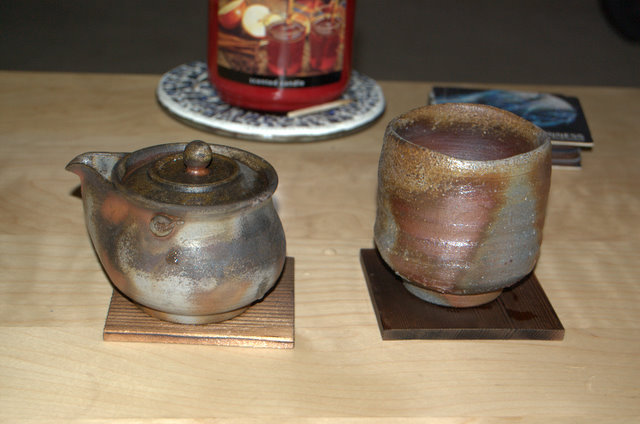
In my opinion, the unglazed Bizen is a very good choice for either tea or sake. Although I'm not that familiar with Bizen and it's taken some time to get used to some of the pieces as far as looks go, what I do have is very pleasant to use. I have one Bizen cup and one 1 + 2 sake set and the taste of tea and sake when using them is exceptionally good. The sake set is one of the ugliest I've seen, but I still prefer to use it over others that are much more pleasant to look at and cost much more. Some call the looks of Bizen "dynamic" because they change drastically as you move around the surface of the piece.Lachlan wrote:I'll shortly be getting a Bizen teapot and a Bizen cup, and am hoping for any information people can provide.
My main questions are:
How to care for them.
Whether they are something to only use one type of tea in
Any other answers to questions I'm too ignorant to ask but need to know
I'm told by vendors who carry Bizen that it's almost impossible to predict beforehand what a piece will look like when it comes out of the kiln, and that it's also close to impossible to get two pieces that match. The loss rate is also very high with about three pieces out of every ten surviving the firing process.
For both tea and sake ware, I rinse with very hot water and let them air dry. Since these pieces are unglazed clay, I never use any soap or detergent.
I only use the Bizen cup for sencha, but I use it for many different variations of sencha. I really don't know how much they will pick up the flavor of the tea. I do know that every tea I've used them for tastes very good in them. The same goes for the sake set.
Re: What should I know about Bizen pottery?
Congrats on your purchase! I love my "stoneware" Bizen cups! I got them from www.inbeya.com (great shop!) where did you find yours?Lachlan wrote:My main questions are:
How to care for them.
Whether they are something to only use one type of tea in
Any other answers to questions I'm too ignorant to ask but need to know
I use them just for Sencha. I think they impart a subtle but noticeable "mineraly" flavor upon the tea which def enhances the Sencha's natural flavor profile. I suspect an unglazed stoneware Bizen Chawan would be great for Matcha too.
In regards to care, I would say the obvious is don't put them in the dishwasher... I just rinse them with hot water.

Sep 27th, '08, 10:42
Posts: 1953
Joined: Apr 6th, '08, 19:02
Location: British Columbia, Canada
Contact:
chamekke
Re: What should I know about Bizen pottery?
See also question 3 ("stoneware") on the Tea Toys facts page, which looks at this question from a tea-ceremony angle. So, with that caveat:Lachlan wrote:My main questions are:
How to care for them.
Whether they are something to only use one type of tea in
Any other answers to questions I'm too ignorant to ask but need to know
mizusashi = cold-water jar used in tea ceremonyTea Toys wrote:Unglazed wares like Bizen and Shigaraki are always used having been soaked in water for a longer time, even overnight, and then just the bottom dried. This gives the surface a "live" and fresh feeling, but it can cause stains on wood and tatami. The ancients had more easy access to tatami than moderns and perhaps found the signs of wear aesthetically pleasing.
One trick to slow down leaking is to soak the flower vase or mizusashi upside down in a narrow container. On a tatami toko, of course for an unglazed hanaire an unfinished wood (kiji) flower board is used, itself also soaked and dried on the bottom.
Bizen ware is very homogenous and the clay is usully very dense and almost like glass. A temperature shock will crack or break Bizen, so be very careful with bowls and tokkuri, ice and hot water. I know from sad experience. Drying is therefore not a big problem.
hanaire = flower container
tokkuri = sake flask
toko = floor (I think)
(Moistened Bizen ware is used a lot in the tea room in the hottest days of summertime, since it's felt to impart a cool feeling.)
______________________
"Never trust a man who, when left alone in a room with a tea cosy, doesn't try it on."
- Billy Connolly
"Never trust a man who, when left alone in a room with a tea cosy, doesn't try it on."
- Billy Connolly
Mar 6th, '13, 15:25
Posts: 5896
Joined: Jan 10th, '10, 16:04
Location: Los Angeles, CA
Contact:
debunix
Re: What should I know about Bizen pottery?
Awakening this thread to celebrate the arrival of my new Bizen yunomi (no photos yet, just took enough time to unpack it before heading to work), and I'm still a little confused.
It has a fairly shiny surface, much smoother appearing than the average yixing, and far smoother than my 'super oni' hagi or iron rich clay shinos. So....should I reserve this for one kind of tea?
And my question, unlike the initial questioner, is not about different senchas, but green vs oolong vs puerh vs white vs black etc.
And does this suggest that I need to soak it before first use or every use?
It feels so good in my hand and I'm itching to use it but don't want to risk any damage with first use.
It has a fairly shiny surface, much smoother appearing than the average yixing, and far smoother than my 'super oni' hagi or iron rich clay shinos. So....should I reserve this for one kind of tea?
And my question, unlike the initial questioner, is not about different senchas, but green vs oolong vs puerh vs white vs black etc.
And does this suggest that I need to soak it before first use or every use?
chamekke wrote:Tea Toys wrote:Unglazed wares like Bizen and Shigaraki are always used having been soaked in water for a longer time, even overnight, and then just the bottom dried. This gives the surface a "live" and fresh feeling
It feels so good in my hand and I'm itching to use it but don't want to risk any damage with first use.

Mar 6th, '13, 17:57
Posts: 20891
Joined: Apr 22nd, '06, 20:52
Scrolling: scrolling
Location: Back in the TeaCave atop Mt. Fuji
Re: What should I know about Bizen pottery?
Hope to see it soon! I always prejudicially soak Bizen upon receiving. Anything looking the way Bizen does, I just automatically think it needs soaking.  But it sometimes does have an earthy smell to it.
Coinkidinky, yesterday I was contemplating posting a new topic, "Bizen, the real Magic Clay" inspired by how wonderfully it brews. But I felt the idea had to ripen in my mind a bit longer.
I realize Bizen may not be for everyone, but I was drawn instantly to its wild and amazing wabi-sabi look ... often reminding me of clay vessels that were recently recovered from a ship that sank 100 or more years ago. O_O
But it sometimes does have an earthy smell to it. Coinkidinky, yesterday I was contemplating posting a new topic, "Bizen, the real Magic Clay" inspired by how wonderfully it brews. But I felt the idea had to ripen in my mind a bit longer.
I realize Bizen may not be for everyone, but I was drawn instantly to its wild and amazing wabi-sabi look ... often reminding me of clay vessels that were recently recovered from a ship that sank 100 or more years ago. O_O
Mar 6th, '13, 18:04
Posts: 5896
Joined: Jan 10th, '10, 16:04
Location: Los Angeles, CA
Contact:
debunix
Re: What should I know about Bizen pottery?
Thanks for the tip. I should have started the soak this morning before I left, D'oh!
And do you use it only for one class of tea or variety of sencha?
And do you use it only for one class of tea or variety of sencha?
Mar 6th, '13, 18:40
Posts: 20891
Joined: Apr 22nd, '06, 20:52
Scrolling: scrolling
Location: Back in the TeaCave atop Mt. Fuji
Re: What should I know about Bizen pottery?
For Bizen pieces I typically use Kyusu for Sencha and Houhin for Gyokuro. But then again, I am almost always drinking Japanese greens. I am guessing you are wondering about "crossbrewing" and drinking in the same vessel. So, unfortunately I cannot answer at this time.
I have noticed that Bizen brew vessels tend to be BIGger ... I sense for creating a larger canvas for the dramatic effects.
They also tends to be thicker walled likely because of the somewhat coarser clay used.
In these regards, they tend to be similar to Hagi ... though not much else similar.
I am guessing you are wondering about "crossbrewing" and drinking in the same vessel. So, unfortunately I cannot answer at this time. I have noticed that Bizen brew vessels tend to be BIGger ... I sense for creating a larger canvas for the dramatic effects.
They also tends to be thicker walled likely because of the somewhat coarser clay used.
In these regards, they tend to be similar to Hagi ... though not much else similar.