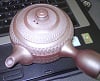
What is the best type of yixing teapot to use for wild arbor (only sheng) puerh?
I am interested in clay type, fireing, wall thickness, shape of teapto etc.
How about this http://cgi.ebay.com/Ben-Shan-Green-Clay ... 7C294%3A30
Jun 17th, '09, 10:07
Posts: 529
Joined: Jul 23rd, '08, 17:07
Location: The Isle of Malta
Re: Best yixing teapot for Wild arbor Puerh tea
I have one of those ben shan's on the slow boat, so I'm very curious as well. I'll let you know in about a month, unless you beat me to it. I think it's hard to buy pots on line, but Scott has a very good reputation and it looks very nice, at least on paper.Oni wrote:What is the best type of yixing teapot to use for wild arbor (only sheng) puerh?
I am interested in clay type, fireing, wall thickness, shape of teapto etc.
How about this http://cgi.ebay.com/Ben-Shan-Green-Clay ... 7C294%3A30
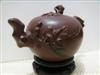
It should be alright. I have some of these benshan lu ni from scott. Makes decent sheng pu. If you want to make great pu. continuously use the pot for long period. Once the pot absorbs enough tea, the tea brews will be nice.
BTW, when you first start, your teas may come out flat as the pot will absorb some of the flavors. Good luck.
BTW, when you first start, your teas may come out flat as the pot will absorb some of the flavors. Good luck.

Jun 17th, '09, 13:25
Posts: 1936
Joined: May 22nd, '06, 11:28
Location: Trapped inside a bamboo tong!
Contact:
hop_goblin
Are you intentionally trying to divide subclasses for sheng? In all practicallity, it will matter very little if at all to brew ancient arbor, wild arbor, or plantation young sheng in one pot and slightly aged to aged puerh in another. When dealing with young sheng, it would be advantageous to use the principle guidlines for green tea. Afterall, young sheng is indeed green tea. I would use a gaiwan or thin walled, perhaps highfired pot to bring out some of the high notes. IMHO, I believe any clay is fine. For aged puerh, I would recommend a thick walled pot that will retain the heat much more effectively. As for clays, I have read that Zini or Pin Zini works well with puerh. However, I am of the opinion that that it has to do more with shape, wall thickness, and how it was fired than what clay. Of course some are more porous than others but even that is up for debate.
Don't always believe what you think!
http://www.ancientteahorseroad.blogspot.com
http://englishtea.us/
http://www.ancientteahorseroad.blogspot.com
http://englishtea.us/

Thanks for the replies, so for young shengs, thin walled high fired, di ciao qing or zhu ni, and for aged medium to thick walled zisha, low fired.
What about the shape, and iron content, I don`t like ben shan lu ni because it is the lowest in iron. I would prefer fast pouring, because puerh needs short infusions.
What about the shape, and iron content, I don`t like ben shan lu ni because it is the lowest in iron. I would prefer fast pouring, because puerh needs short infusions.

Jun 18th, '09, 02:31
Posts: 196
Joined: May 1st, '09, 22:28
Location: Malaysia
Contact:
oldmanteapot
Hi Oni,Oni wrote:I would prefer fast pouring, because puerh needs short infusions.
If you're refering to young sheng, then I would agree with you. But for aged pu, be it shu or sheng, a longer infussion time would be prefered.
One of the many ways of testing the quality and grade of the pu is to infuse for a long period of time. I personally prefer long infusion time. Sometimes up to 5 minutes at the 3rd or 4th brew. Depending on the age of the pu, sometimes even longer. Well kept quality pu (not necessarily aged) can be brewed for more than 10 infusions easily.
So, IMHO, it's a sweeping statement to say that pu'erh needs short infusions.
Cheers!!

Jun 18th, '09, 03:50
Posts: 196
Joined: May 1st, '09, 22:28
Location: Malaysia
Contact:
oldmanteapot
I would go with a Gaiwan for young Sheng.hop_goblin wrote:When dealing with young sheng, it would be advantageous to use the principle guidlines for green tea. Afterall, young sheng is indeed green tea. I would use a gaiwan or thin walled, perhaps highfired pot to bring out some of the high notes. IMHO, I believe any clay is fine.
I am more inclined to agree with Hop. It's more of the ability of the pot to retain the heat and how it was fired. I wouldn't use any high fired teapots nor would I use fine clay i.e. Zhuni or Duan Ni for aged pu.hop_goblin wrote:However, I am of the opinion that that it has to do more with shape, wall thickness, and how it was fired than what clay. Of course some are more porous than others but even that is up for debate.
Cheers!
I second oldmanteapot.oldmanteapot wrote:I would go with a Gaiwan for young Sheng.hop_goblin wrote:When dealing with young sheng, it would be advantageous to use the principle guidlines for green tea. Afterall, young sheng is indeed green tea. I would use a gaiwan or thin walled, perhaps highfired pot to bring out some of the high notes. IMHO, I believe any clay is fine.
I am more inclined to agree with Hop. It's more of the ability of the pot to retain the heat and how it was fired. I wouldn't use any high fired teapots nor would I use fine clay i.e. Zhuni or Duan Ni for aged pu.hop_goblin wrote:However, I am of the opinion that that it has to do more with shape, wall thickness, and how it was fired than what clay. Of course some are more porous than others but even that is up for debate.
Cheers!